Stefano Boeri Architects, a Milan-based urban planning firm, presented their home city with a world-renowned concept demanding careful analysis. Officially opened in October of 2014, Bosco Verticale (Vertical Forest) won the International Highrise Award in November 2014. A year later, the Council on Tall Buildings and Urban Habitat (CTBUH) selected Bosco Verticale as the “2015 Best Tall Building Worldwide”.
The towers, of 110 metres and 76 metres, host 900 trees (each measuring 3, 6 or 9 metres) and over 2,000 shrubs and floral plants. This Vertical Forest generates its own microclimate, absorbing CO2 and dust particles and adding oxygen and humidity to the surrounding environment. Each Vertical Forest is the equivalent of 7000 m2 of forest and, additionally, opens up new public realm green spaces in a previously tightly packed urban environment. Milan residents can enjoy the seasonal colours of urban afforestation.

Quick to spot the potential, China has commissioned two ‘vertical forest’ towers in the City of Nanjing to be completed in 2018. With approximately 1100 trees and 2500 cascading plants Stefano Boeri Architects calculate that these towers will absorb 25 tons of carbon dioxide and release 22 tons of oxygen annually.
Backing a planning application for the construction of two 25 storey towers in Birmingham, UK, Chinese investors have identified the benefits these principles bring to the booming UK regeneration scene. Each of the 500 residents will have access to green, tree-covered terraces in startlingly designed facades that have been likened to the fabled hanging gardens of Babylon.
With the government fretting over the apparent impossibility of meeting the enormous shortfall in the supply of new residential accommodation and the, not unrelated, crisis of air pollution, the day of high-rise gardens offers the combination of biophilic design, pollution reduction, growth of site values (including the improved viability of associated commercial/retail/leisure facilities) plus reduced commuting journey times and costs.
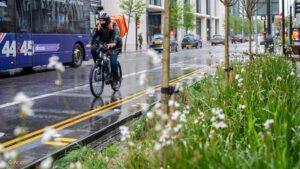
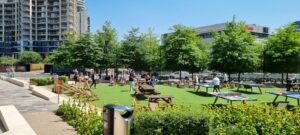
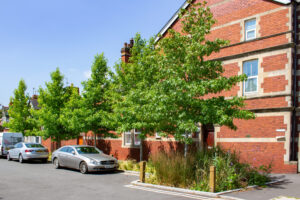
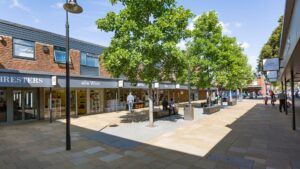
Already established as providers of innovative and sustainable solutions to the challenges of green infrastructure in urban environments, GreenBlue Urban’s line of urban tree planting systems and LID stormwater management solutions provides everything that trees need to reach maturity in even the harshest of urban settings, while protecting built infrastructure.
The success of vertical forest towers in Milan is spurring similar schemes from China to Birmingham and beyond. On the potential of green tower construction, Stefano Boeri commented, “We have been asked to design an entire city (in China) of 100 or 200 buildings, all with trees… By 2020 we could imagine having the first forest city – in China.”