
Planning expectations around SuDS, tree planting, biodiversity and environmental performance continue to evolve. At the same time, schemes must remain commercially viable, buildable and attractive to occupiers and purchasers.
The challenge is balancing planning, programme and commercial priorities while delivering practical infrastructure that works successfully within real development environments.
Our systems are designed for the pressures of live development projects, where programme certainty, coordination and finished quality all matter.
We support residential, commercial and mixed-use developments through solutions that integrate tree planting, drainage and public realm infrastructure within practical site layouts.
We help developers deliver schemes that balance compliance, constructability and long-term value.
GreenBlue Urban supports development projects from early planning and design through to construction delivery and handover.
This approach helps development teams reduce redesign risk while supporting efficient delivery and durable finished outcomes.
We provide practical systems supported by technical guidance, specification support and coordinated delivery input suited to real construction programmes.
Our systems are used across residential, commercial and mixed-use developments of varying scale, helping developers deliver attractive, compliant and durable environments.
These projects demonstrate practical approaches to integrating tree planting, drainage and landscape infrastructure within complex development sites and live construction programmes.
Combining sustainable drainage and urban landscape infrastructure within a major residential development to help manage surface water while creating greener, more resilient public spaces throughout the scheme.
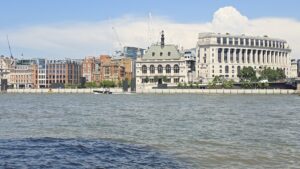
Integrating urban tree planting within a major linear park development to support healthy canopy growth, improve biodiversity and create a greener, more resilient public realm through the centre of Nine Elms.
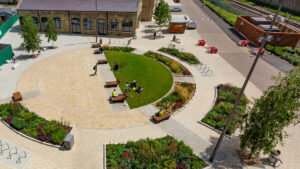
Combining sustainable drainage and landscape infrastructure within a residential development to help manage surface water while creating greener, more attractive public spaces throughout the scheme.
Updates, commentary and technical insight from the GreenBlue Urban team.
Need help selecting the right solution for your project?
Whether you require technical guidance, specification support, CAD details or product information, our team is here to help.
Complete the form and we’ll be in touch.
Coordinated tree and SuDS infrastructure can help a development demonstrate surface-water management, urban greening, biodiversity, climate resilience and high-quality public realm. The design should show how these outcomes will be delivered, not just label areas as landscape or SuDS. Soil volume, drainage calculations, planting, maintenance and phasing need to be resolved sufficiently to support planning submissions, condition discharge and later construction.
Often, yes. Soil cells can provide rooting volume beneath pavements, while SuDS tree pits, rain gardens and planters combine drainage and landscape functions within shared footprints. Integration works best when considered during masterplanning, before buildings, roads, utilities and levels are fixed. It does not remove spatial requirements, but it can use streets and public realm more efficiently than treating drainage and greening as separate late-stage additions.
Yes. New developments allow infrastructure to be coordinated from the outset, while retrofit projects may use modular, flexible or contained systems to work around existing constraints. The design process differs: retrofit needs accurate surveys and careful construction planning, whereas new-build schemes need early protection against later value engineering or utility changes. Both require clear performance, maintenance and handover information.
Early input can identify soil-volume, utility, loading, drainage and level conflicts before they affect planning discharge or construction. It also helps the team choose realistic systems, set budgets and coordinate responsibilities. Late redesign can lead to reduced performance, programme delay or remedial work. Early coordination is particularly valuable where one feature is expected to satisfy several objectives, such as drainage, biodiversity and public-realm quality.
Healthy trees and visible SuDS can improve shade, drainage resilience, biodiversity, amenity and the quality of streets and shared spaces. These outcomes can support occupier appeal and a stronger sense of place, but only if the infrastructure is durable and maintainable. Whole-life value depends on successful establishment, clear ownership and systems that continue to perform after the development has been completed and handed over.