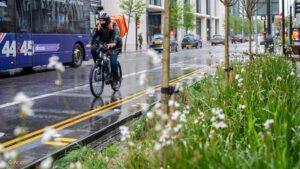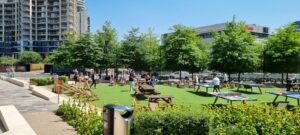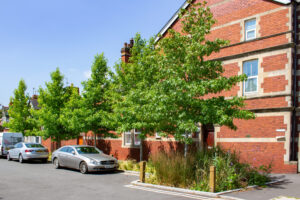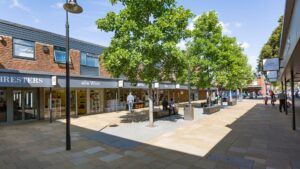
The 2016 International Low Impact Development Conference took place in beautiful Portland, Maine. It highlighted the mainstreaming of green infrastructure and Low Impact Development (LID) in municipal planning and policy making, as well as new and existing work and research in the United States and around the world.
Organized by the EWRI Urban Water Resources Research Council (a division of the American Society of Civil Engineers), the conference provides an international forum to present the latest technologies and case studies related to low impact development and green infrastructure available to the industry – including new and continuing research, developments, and community adoption of LID throughout the United States and internationally.
Internationally recognized sustainability experts from every aspect of the industry came together to discuss the latest development of LID and green infrastructure principles and technologies. The rising challenge of sustainable stormwater management and how it can be made achievable for all cities was of top priority.
Low Impact Development is a design methodology that responds to the increasing drainage challenges brought on by urbanization.
As a key sponsor of the event, and a major solutions provider in the LID industry, GreenBlue Urban attended the conference to contribute to the worthy cause and share our expertise on the topic. GreenBlue consultants took part in several of the educational sessions – most notably “LID Performance and Research in Cold Regions” and “Tools for Green Infrastructure Planning & Design”.

Why is LID so important?
Drainage issues arising from increased levels of urbanization throughout much of the world has exacerbated the limitations of conventional surface-water drainage measures, which were designed to transfer stormwater from where it lands to a soak-away or a watercourse as quickly as possible. This method increases the risks of flooding, environmental damage, and urban diffuse pollution; since rainwater runoff usually carries contaminants including oils, heavy metals, pesticides, fertilizers, chemicals and other urban matter. Low Impact Development (or otherwise referred to as SUDS or WSUD) represents a design methodology that responds to these increasing drainage challenges.
How can street trees play a role?
GreenBlue also showcased our world-renowned ArborFlow system at the conference. ArborFlow sustainably manages stormwater by integrating urban runoff mitigation into tree pit design to help keep stormwater onsite while irrigating the trees at the same time.

Integrating stormwater management into urban tree pit design is arguably the most sustainable stormwater mitigation option available. The benefits there are to turn runoff from a hinderance to an opportunity are endless. Urban drainage tree pit systems, such as the GreenBlue ArborFlow, have been developed as an environmentally robust, yet effective, means of managing stormwater runoff. It significantly reduces the velocity and flow rate of surface water runoff in paved areas and contributes towards meeting the required discharge rates. ArborFlow also filters out harmful pollutants using a special species of reed (available in the 4-stage system) that collects, processes and breaks down any pollutants and contaminants carried in runoff. The system prevents particles in the water from passing through into the trees rooting area, or clogging up the troughs.
ArborFlow’s design allows the water to be discharged into surrounding subsoil to be absorbed by the trees’ root system, or to find its way into the specially designed flow-control chamber positioned on the outfall of the tree pit.