As we all are aware, land is a limited commodity – it’s not being made anymore. Pressure on housing means that as economies we need to provide homes for our increasing population, and there is a strong case for resisting urban sprawl into our green fields.
Land values have reflected these challenges, with a direct correlation between availability and cost. It is often far cheaper to develop a “green field” site, as this has few of the complications that can be encountered when seeking to build on a previously developed site, although main utilities may have to be run a long way. Green field sites are also advantageous, as new technologies and ideas can be accommodated without compromising existing infrastructure.
Recent new legislation relating to sustainable drainage systems have given developers a huge challenge. How can storm water be contained on site, to be released in a controlled way without losing land that could be built on?
Often below ground tanks or chambers have been used, but local authorities and statutory utility companies are reluctant to adopt such installations, as they may bring long term liabilities for maintenance. Often attenuation basins, balancing ponds, swales and other above ground features have been successfully created, providing plentiful accommodation for water storage in a rainfall event along with amenity and biodiversity features. However, these options eat into available building land, and brown field sites often have contamination issues making excavation expensive and hazardous.
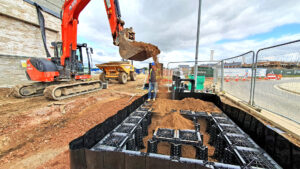
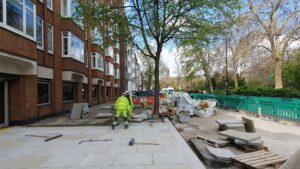
GreenBlue Urban are extremely conscious of the tight constraints that house builders work under and have designed a modular storm water management system that is installed below mandatory hard surfaces such as highways, pavements and access drives; they also incorporate sufficient soil medium to grow trees and plants. This ticks all the boxes outlined in the CIRIA “Four Pillars of SuDS” mentioned in the SuDS Guide 2015, but also releases additional land for construction. If the land is not suited to construction, additional garden space could be made available, adding value to the new properties.
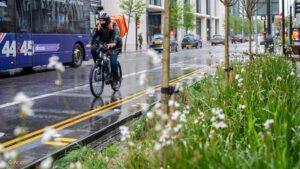
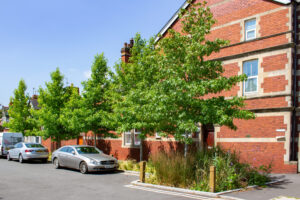
Many new developments are under pressure to increase tree canopy cover and to allow for green corridors for wildlife movement within the site. GreenBlue Urban Arborflow systems are uniquely placed to enable all of these criteria to be met without encroaching on valuable land, maintaining the amenity values, holding up property values and creating a pleasant place to live work and play.
By specifying GreenBlue Urban ArborFlow systems, a long-term solution is available to make every development sustainable for the long term resident, and profitable for the developer.