GreenBlue Urban were privileged to contribute to the Urban Tree Pit Seminar held at the Liverpool BID office, organised by the Mersey Forest. The Mersey Forest, alongside many other stakeholders across the city have been awarded funding by the Horizon 2020 project* to engage in several pilot urban greening projects. Namely the URBAN GreenUP project who’s main aim is to mitigate the effects of climate change, improve air quality and water management through nature based solutions.
It is an exciting time for Liverpool – £2.8m is available for the team to integrate urban tree pits into strategic locations across the city. GreenBlue Urban were able to share our wealth of experience and to contribute to the roundtable discussions including tree officers, planners and landscape architects from the city council.
It was encouraging to see that many of the attendees had come to realise that the tree sand solution, although often seen as the cheapest option, would not provide the long-term benefits or enable the newly planted trees to not only survive, but to thrive. The concept of mimicking the forest floor environment as closely as possible chimed well with the GreenBlue Urban soil support solution, integrating uncompacted, quality soil in sufficient rooting volume.
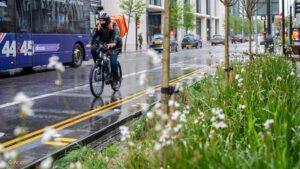
The Mersey Forest team explained how the focus would be on surmounting retrofit challenges, using tree pits as part of SUDs schemes and their desire to monitor and measure the added benefits – adapting to climate change, increasing biodiversity and improving air quality. There will be an exciting retrofit scheme undertaken in collaboration with the city’s Business Improvement District, there will be SUDs compatible tree pits integrated which will deliver multiple benefits to those in the heart of the Northern gem. It is encouraging that business stakeholders are also engaged in the design and integration of the tree pits.

This is an excellent addition to the evidence that has already been produced by Treeconomics and the Victoria BID in London looking at the benefits of their canopy cover. Community engagement is also vital and across the “Baltic Corridor” site floating gardens and SUDs tree pit design will be the result of a wide collaboration between business, communities and SMEs. Air quality is a key concern for the URBAN GreenUp initiative. Along highways intersections around Jericho and Otterspool there will be a unique opportunity to gather data and monitor the improvements to air quality delivered through green and blue infrastructure interventions.
The Arborflow system and recent GreenBlue Urban innovations can assist in the delivery of these objectives and as an organisation we are always keen to engage in research and innovation projects so that we can deliver cutting edge solutions to the market.
*The Urban Greenup project has received funding from the European Unions Horizon 2020 research and innovation programme under grant agreement No 730426.