Underground utilities are one of the most common constraints encountered when designing tree planting in streets and public spaces.
Water mains, drainage, electricity, telecommunications and other services already compete for limited space below ground. Add the soil volume required to establish a healthy tree, and it can appear that there simply isn’t enough room for both.
As a result, trees are sometimes removed from schemes or significantly reduced in number when utilities are identified.
But the presence of underground services does not automatically prevent successful tree planting.
With the right below-ground design, trees and utilities can often be accommodated within the same constrained urban environment. The key is understanding how tree roots behave, protecting sufficient quality soil for the tree and considering utilities as part of the tree pit design from the outset.
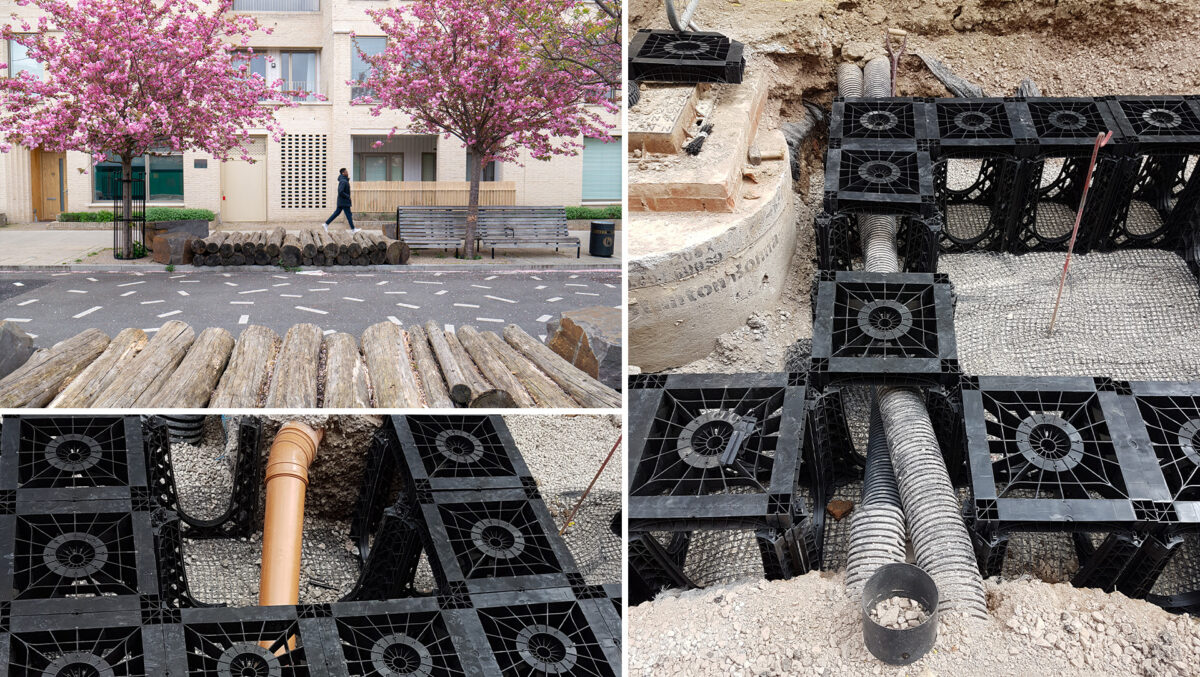
Why Do Tree Roots Grow Around Utilities?
Tree roots grow where conditions allow them to access the water, oxygen and nutrients they need.
In many urban environments, this is difficult.
Soil surrounding roads and pavements is often heavily compacted to create the structural support required for the surface above. While necessary for the hard landscape, heavily compacted soil can restrict root growth, water movement and gaseous exchange.
Utility trenches can create a different environment.
When pipes and ducts are installed, the surrounding ground is excavated and typically reinstated using materials such as sand, gravel or other relatively free-draining backfill. These areas can sometimes offer easier pathways for roots than the heavily compacted soil surrounding them.
Roots are therefore not necessarily being attracted to the utility itself. They are responding to the conditions around it.
This is an important distinction.
If a tree has insufficient access to suitable soil within its intended rooting area, its roots will continue searching for better growing conditions elsewhere.
Soil Volume Is Part of the Solution
One of the most effective ways of reducing conflict between trees and surrounding infrastructure is to provide an appropriate rooting environment from the beginning.
Urban trees require sufficient volumes of suitable soil to establish healthy root systems and mature successfully.
Simply providing a large excavation is not enough. The soil within it needs to remain capable of supporting root growth, with adequate access to water, oxygen and nutrients.
This is particularly challenging beneath pavements because the requirements of the tree and the requirements of the hard landscape can conflict.
The pavement needs structural support. The tree needs uncompacted growing media.
Soil cell systems provide one method of separating these two functions.
Rather than relying on the soil itself to support the pavement, the structural system carries the loads above while protecting a volume of soil beneath it.
This creates an environment where roots can establish within suitable growing media while the surface remains capable of supporting pedestrian or vehicle loading.
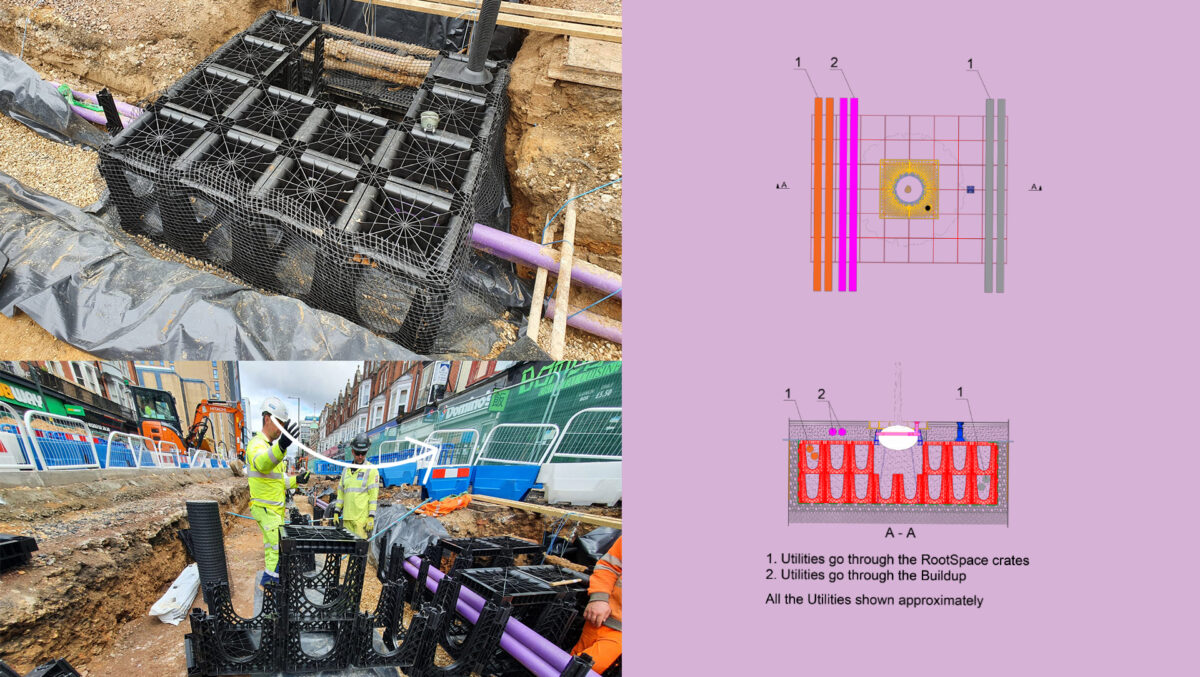
Can Utilities Pass Through Soil Cells?
Utilities do not necessarily need to sit entirely outside the tree rooting area.
Where carefully designed, services can be incorporated through soil cell systems, allowing available below-ground space to be shared rather than allocating separate corridors to trees and utilities.
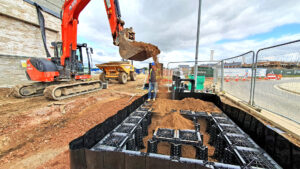
GreenBlue Urban’s RootSpace system, for example, can accommodate service ducts and pipes up to 300mm in diameter within the soil cell construction.
This can be particularly valuable within existing streets, where the available underground space may already be occupied by numerous services.
Instead of approaching the design as a choice between utilities or trees, the objective becomes understanding how both can be coordinated.
Early consideration is important.
Utility routes, tree locations, soil requirements and access arrangements should ideally be reviewed together rather than treating the tree pit as something to be fitted into whatever space remains at the end of the design process.
What Happens When Utilities Need Maintenance?
Providing space for utilities is only part of the consideration.
They must remain accessible throughout the life of the scheme.
Any design that incorporates utilities close to or through a tree rooting environment therefore needs to consider how those services can be identified, accessed and maintained without unnecessary damage to the tree or surrounding infrastructure.
Within a RootSpace installation, the upper sections of the system can be removed to provide access to services where required. Warning tape can also be installed above the system to alert future contractors to utilities below before excavation reaches the service.
This coordination can provide greater clarity around where utilities are located while helping to reduce the risk of accidental strikes during future works.
The important point is that maintenance needs to be considered during design, rather than after installation.
Designing Tree Pits Around Existing Utilities
Every street is different.
There will be sites where utilities genuinely restrict the location, size or configuration of a tree pit. Major infrastructure, statutory clearance requirements, access chambers and heavily congested service corridors all have to be taken into account.
But the discovery of utilities should trigger coordination rather than automatically removing tree planting from the scheme.
A successful approach should consider:
- the location and depth of existing and proposed services;
- access requirements for future maintenance;
- the target soil volume for the proposed tree;
- the quality and compaction of the available growing medium;
- structural loading from the pavement or carriageway above;
- root management where additional protection is required; and
- opportunities to adjust the shape of the rooting area around constraints.
Tree pits do not always need to be simple rectangular excavations directly beneath the tree.
Where space is constrained, soil can potentially extend laterally beneath surrounding hard surfaces or be configured around utilities and other below-ground infrastructure.
The priority is creating a sufficient connected rooting environment while maintaining the function and accessibility of everything else below ground.
Should Utilities Prevent Urban Tree Planting?
In some locations, underground constraints will inevitably limit what can be achieved.
But in many cases, utilities and urban trees can successfully coexist.
The presence of services should therefore be viewed as a design constraint to resolve, rather than an automatic reason to abandon planting.
This requires early coordination between landscape architects, engineers, utility providers, contractors and tree specialists. The earlier the below-ground environment is understood, the greater the opportunity to create a solution that works for both the tree and the surrounding infrastructure.
As our streets are asked to accommodate more infrastructure above and below ground, this coordinated approach becomes increasingly important.
Urban trees need sufficient soil to establish and mature. Utilities need protection and ongoing access. Hard surfaces need structural support.
Good below-ground design considers all three together.