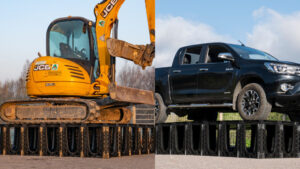
Have you ever grown a tree in rocks? Trees need appropriate amounts of nutrient-rich, moist, well-aerated, and uncompacted soil in order to mature in the urban environment. In addition to the nutrients that trees absorb from the soil through their root system.
A method that has often been utilized to deal with compaction issues harming urban trees is structural soil. Structural soil is made up of 80% crushed stone and 18-20% soil, compacted to 95% proctor density (hardly uncompacted). The compacted rock creates the structural support with small void spaces for soil, leaving the tree roots to attempt the impossible of making use of the soil-filled voids.
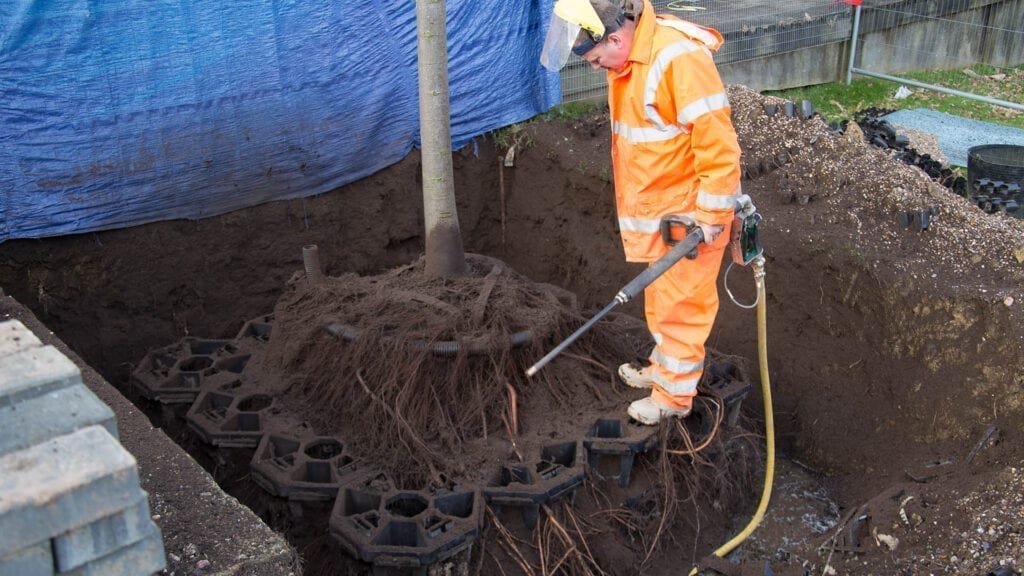
There is the misconception among many that structural soil/sand and soil cells have comparable capabilities and benefits for urban trees, which results to the products being specified as equals. However, this not factual. Structural soil/sand is a heavily compacted media with little to no nutrient-rich soil. Trees may grow well in it at first, but once the soil in the matrix is exhausted and along with a very fragmented and weak root system, the trees begin to decline.
GreenBlue Urban was invited to participate in a study at Bartlett Tree Labs in North Carolina to study the tree growth effectiveness of several load-bearing soil options. Tulip poplar trees were planted in two trenches, two feet deep and five feet wide, to replicate a city sidewalk. Six different subsurface soil treatments were installed, with each plot containing approximately 42 cubic feet of (1m³) of soil.
The test pits were made up of the following,
- Control planting, standard soil mix compacted to 80% proctor.
- Compacted control, 95% proctor compaction to simulate the typical urban environment.
- 2 different types of Soil cell technologies
- Sand based Structural Soil, consisted of four parts medium (concrete) sand, one-part topsoil loam, and 1.5 parts mature compost and compacted to 94-96% Proctor.
- Structural Soil consisted of 80% #5 stone, 18-20% soil mix, and .003% hydrogel – compacted to 95% Proctor (mixed to Cornell University’s specification for CU Structural Soil)
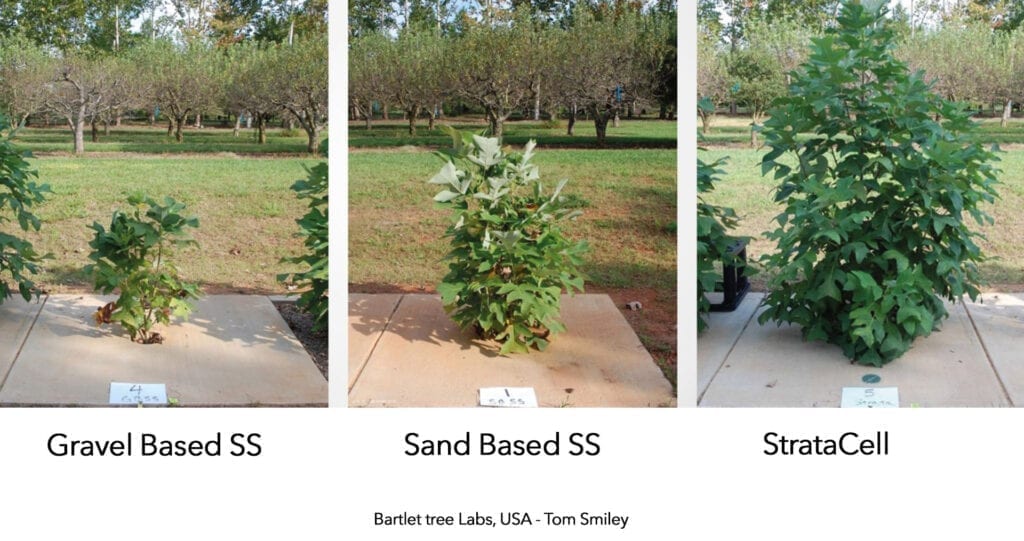
After one year of growth the height and spread were measured and clearly illustrated that soil cell technology significantly outperformed all the other methods, with GreenBlue Urban’s Soil Cell system showing the most tree growth. The speed at which such drastic results were determined is of great interest to the research of suspended pavement technologies, other studies performed by Bartlett Tree experts in this area have taken several years to achieve significant results.
Dr Thomas Smiley, an Arboricultural Researcher at Bartlett, directed the research which was originally intended to be a five to ten-year study, however, because of significantly obvious results after just one year, a much faster than expected conclusion has been made and the study was condensed. “We are seeing large differences in tree health and growth in the Soil Under Pavement plot that we installed in summer of last year,” explains Dr Smiley. Even before research data was completed, Dr Smiley stated that “the photos tell most of the story.”
To read more about structural soil and soil cells download GreenBlue Urbans resource “Structural soil vs soil cells” here.