Will this lead to tree-lined cycling and walking routes?
Active Travel England, the recently formed government’s executive agency responsible for making walking, wheeling, and cycling the preferred choice for everyone to get around in England, has finally published local authority active travel capability ratings.
It follows on from the government’s vision for cycling and walking set out in its 2020 strategy According to the strategy, physical inactivity alone was found to be costing the NHS up to £1bn per annum.
To tackle these issues, a bold vision was set for half of all journeys in towns and cities to be cycled or walked by the year 2030.
The active travel capability ratings are based on an earlier self-assessment and involve English local authorities outside London. The ratings guide the initial allocation of Active Travel and Capability Funding, such as the £200 million announced last month.
“Done well, active travel provision creates attractive, healthy places where people want to live and invest, benefiting local economies and returning very high value for money, “ says Danny Williams – CEO of Active Travel England in his foreword introducing the new local authority active travel capability ratings.
The capability ratings generated through a local authorities self-assessment focused on three areas: 1) local leadership; 2) plans; and 3) delivery record. Thus falling short in assessing how local authorities are meeting their climate change obligations and maximising opportunities for greening and concurrently cooling our towns and cities.
This is in spite of the 2020 government strategy clearly setting out the benefits of cycling and walking when it comes to combatting climate change; improving air quality and thus preventing 8,300 premature deaths each year; as well as providing opportunities to improve green spaces and biodiversity.
The health and environmental benefits are also recognised in the government’s latest document, the second cycling and walking investment strategy (CWIS2), which references the government’s 25-year environment plan.
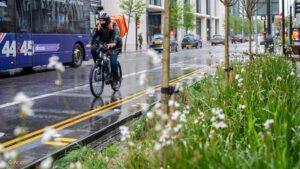
With reports of government funding less than initially expected there remains a glimmer of hope that not only will half of all journeys in towns and cities be cycled or walked by the year 2030. But these activities will take place along tree-lined green and pleasant routes that will contribute to improving our health and well-being whilst making space for nature to thrive.
Looking for Green and Blue Inspiration?
GreenBlue Urban has a wealth of examples of implementing blue and green infrastructure in the urban environment including the creation of green and leafy tree-lined cycle and walking routes:
The key is involvement in the master planning stage where GBU have supported the design and successful implementation, clearly evident at Wapping Wharf, which transformed a much-loved section of Bristol City, The design included green corridors to enhance pedestrian footfall and cycleways for active travel, allowing this area to become socially inclusive for all.
Leonard Circus is a well-documented “shared space” project with the London Borough of Hackney, the well established 11 trees planted in GBU’s ArbrSystem have proved to not only be aesthetically pleasing for passers-by on foot and bicycle but provided a welcome backdrop to market day with onsite seating for all to enjoy.
Sauchiehall Street is the pilot scheme to showcase how green infrastructure can be used to change human behaviour by challenging the dominance of vehicles in the public realm. Twenty-eight specimen trees have been planted in full GreenBlue Urban ArborSystems, providing strong visual segregation between vehicles and pedestrians/cyclists.
Walthamstow High Street – a multi-award-winning “Mixed-use” High Street, having achieved the Planning & Placemaking Award 2016 is now equipped for the latest phase of its history, and as the green infrastructure matures, it will be providing mitigation to climate change, both cooling and stormwater management through the healthy canopy over, for generations to come.
We would like to hear from you – Do you prefer to cycle and walk along routes lined with trees? Tell us why on social @GreenBlueUrban using#Activetravel.